The State of the Modern Family: 50% of Seniors Now Share Their Location, and They're Not Looking Back
The Connected Grandparent
For years, Silicon Valley assumed younger generations would define the future of tech. But new data suggests something more surprising is happening.
Gen Z may have normalized location sharing, but seniors (65+)* are turning it into a daily habit.
Findings from Life360’s 2026 State of the Modern Family report, based on a survey of 1,000 U.S. adults and insights from nearly 98 million Life360 members, reveal that while younger generations helped make location sharing mainstream, older adults are increasingly defining its role in everyday family life.
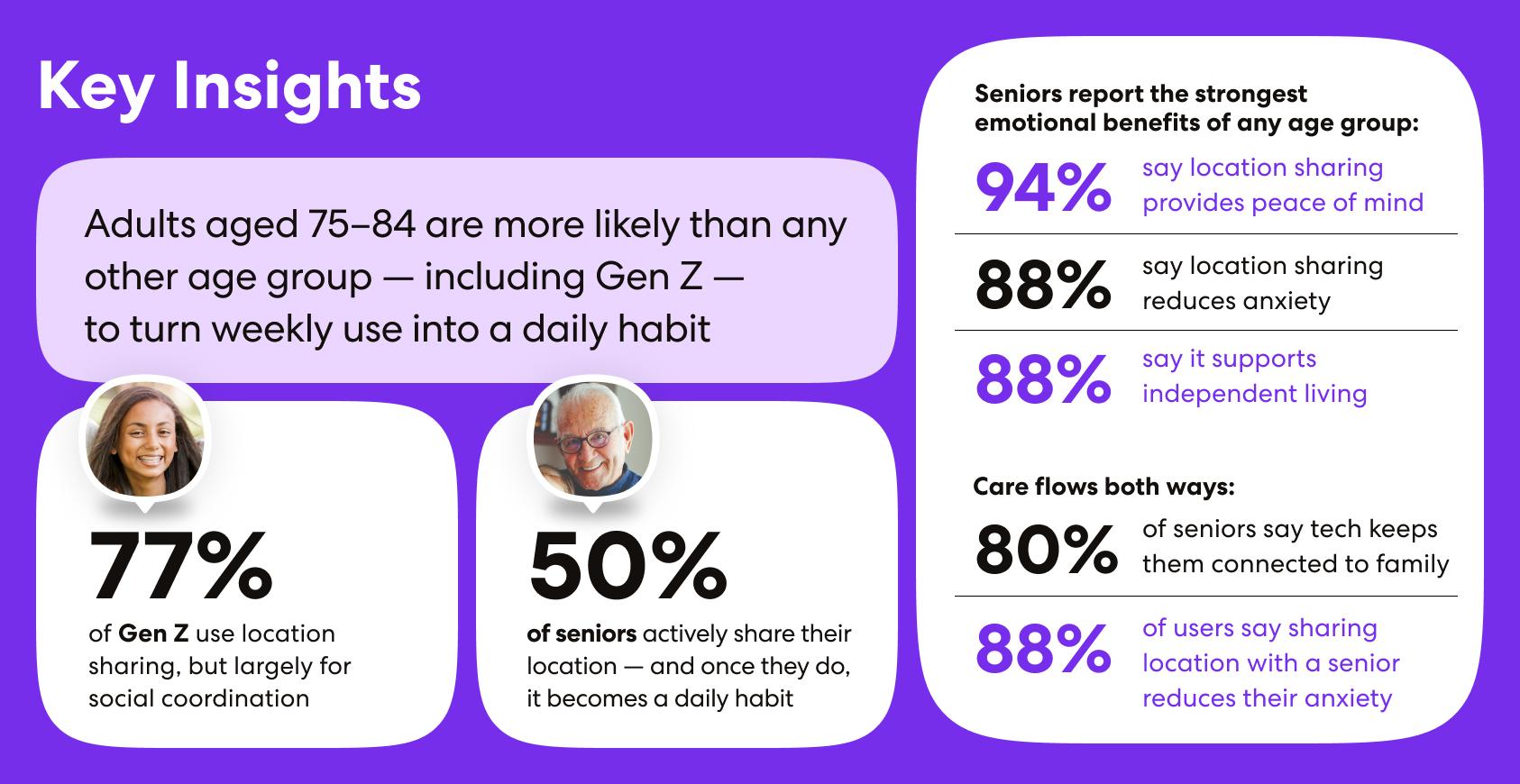
50% of seniors actively share their location, and once they start, many turn it into a daily habit.
And seniors are not just adopting it. They are using it differently: more intentionally, more consistently, and in ways that strengthen their mental health, relationships, and independence.
What the data tells us
Seniors aren't just trying location sharing, they're making it a daily habit.
1 in 2 seniors actively share their location, per Life360's 2026 State of the Modern Family report.
94% of seniors who share their location say it gives them peace of mind.
It's not about being watched. It's about staying independent without putting family on edge.
Grandparents are shaping the future of family tech just as much as Gen Z.
Tech Natives vs. Tech Newbies
At first glance, Gen Z appears to be leading the way, with 77% actively sharing their location, often using it to coordinate plans, meet up with friends, and stay socially connected.
But usage alone doesn’t tell the full story.
As expected, seniors are less likely to adopt location sharing in the first place. Yet once they do adopt, the impact is deeper, more emotional, and more likely to turn into a habit.
From Social Tool to Emotional Infrastructure
For seniors, location sharing goes beyond coordination, becoming a source of reassurance that reflects real emotional needs around care, connection, and independence.
Among seniors* who share their location:
94% say it provides peace of mind
88% say it reduces anxiety
88% say it allows them to live independently without causing worry
These are the strongest emotional outcomes across all age groups, including respondents who identified as parents. Perception also improves with use. The majority (61%) say they feel more positive about location sharing today than when they began using it.
What starts as an experiment often becomes something indispensable.
The Late Adopters Who Become Power Users
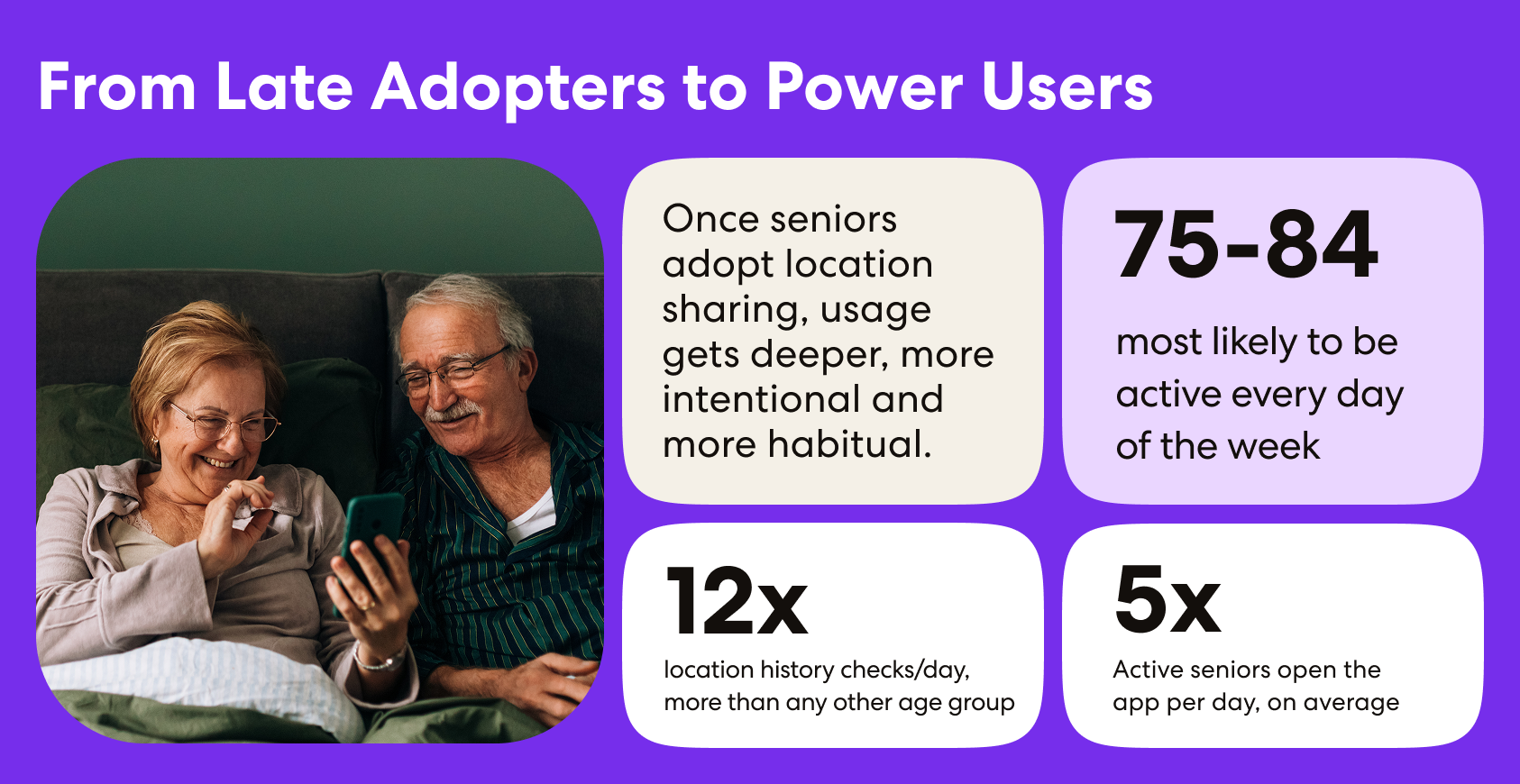
Adults aged 75–84 are the most consistent users on the platform. They're more likely than any other age group, including Gen Z, to be active every single day of the week, not just weekly.
On average, active seniors on Life360
Open the app 5 times per day
Check location history around 12 times a day — more than any other age group on the platform
They also engage more deeply with features that provide context, not just visibility. Seniors 75+ check location history more than any other age group on the platform, and the older the user, the more intensely they look. Driver Reports follow the same pattern — the only feature where engagement increases with age in both adoption and intensity. Users aged 85+ view reports 3.45 times per viewer, the highest on the platform.*
The result is a generational split: Gen Z uses location sharing broadly across social connections, while seniors use it more selectively but far more habitually.
Location Sharing for Autonomy
For decades, independence was defined by privacy. Living on your own. Not being watched.
The data suggests the definition of independence is quietly changing.
Many seniors are now choosing visibility to remain independent without feeling isolated.
50% now use location sharing
77% have adopted at least one new technology to stay independent or connected
69% are comfortable relying on digital tools to remain independent
Location sharing is not replacing independence. It is enabling it.
Distance Makes Location Sharing Fonder
The shift is being driven by longer drives, plane rides, and even borders between families.
41% of Americans have immediate family in a different state
10% have immediate family in a different country
31% say their family has moved farther apart over time
At the same time, 92% of seniors say they plan to live independently for as long as possible
Distance has not weakened family ties, it has made them more complex, with more than 80% of Americans now coordinating communication and logistics across households, cities, and time zones.
At its core, the need is simple. People want to know that their loved ones are okay.
Rise of the Connected Grandparent
The result is the “connected grandparent.” Not someone being looked after, but someone actively plugged into day-to-day family routines, from across town or across the country.
What was once thought of as “monitoring” has become active participation.
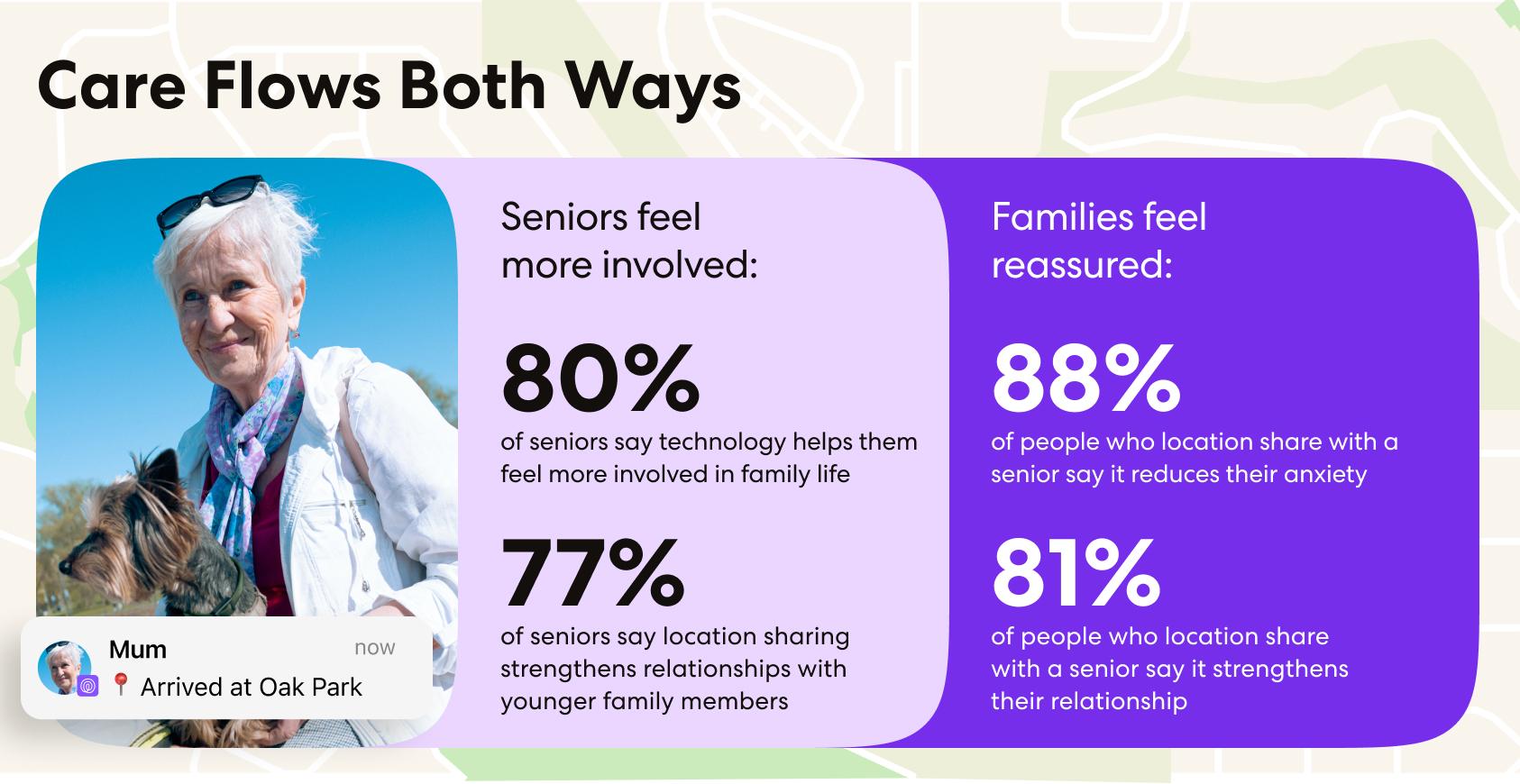
80% of seniors say technology helps them feel more involved in family life
77% of seniors say location sharing strengthens relationships with younger family members
And that connection reduces anxiety on both sides:
88% of people who location share with a senior say it reduces their anxiety
81% of people who location share with a senior say it strengthens their relationship
Care is no longer one-directional. It’s shared.
A New Kind of Family Network
On Life360, this shift is already happening at scale. The platform is increasingly becoming essential infrastructure for distributed families.
Over the past year, adults (65+) have become one of Life360’s fastest‑growing segments.
Life360 has seen a 47% increase in Circles with members 65+
Multigenerational Circles have grown 42% over the same period, growing faster than overall Circle growth
And for these families, distance is not an exception; it is a defining feature.
Nearly 1 in 4 families with a senior member are separated by more than 250 miles
Both cross-border and cross-time-zone family Circles have increased 25–30% YoY
This is a reflection of how modern families are organizing across generations, distance, and daily life.
The Future of Family Tech
The future of family tech is not just about coordination. It's about connection, care, and community across distance.
It is becoming always-on rather than episodic, shared rather than one-directional, and embedded in daily life rather than reserved for emergencies.
It’s warmer, more human, and increasingly shaped by seniors as much as younger generations.
Survey Methodology:
*Seniors in the survey are defined as those aged 65+
This scientific random sample of 1,000 U.S. adults (aged 18 - 80) was surveyed on March 25, 2026. Sampling was calibrated to obtain a statistically representative sample aligned with U.S. age and gender demographics. DKC Analytics conducted and analyzed this survey using a sample procured through the Pollfish survey delivery platform, which distributes online surveys globally via mobile apps, the mobile web, and the desktop web. No post‑stratification weighting was applied to the results.
Life360 internal data analyzing behavioral patterns across ~98 million members, 2026